Supernatural Secrecy Rule
Holding Out for a Hero ▸ Stiles Stilinski (2)The Supernatural Secrecy Rule is the practical code that keeps the supernatural world hidden inside ordinary life in Beacon Hills. It is not presented as a formal statute, but as a repeated survival discipline: conceal relationships, disguise investigations, avoid witnesses, and control what schools, police, families, and strangers are allowed to see. The rule protects vulnerable people from hunters and public panic, yet it also forces teenagers into secrecy, illegal improvisation, and increasingly unstable forms of trust.
Definition and Purpose
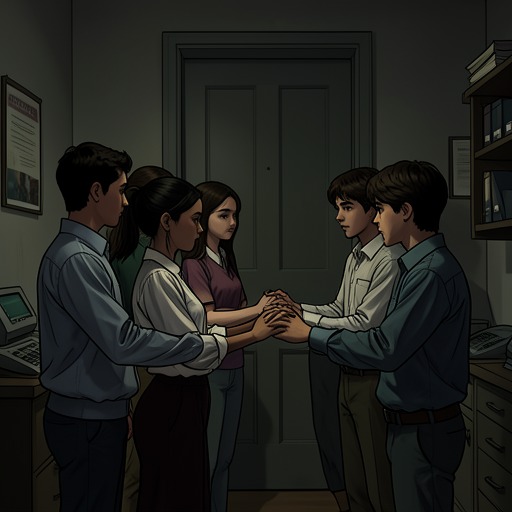
The rule operates through concealment rather than open enforcement. Scott McCall and Allison Argent continue their forbidden relationship after Mr. Argent forces them to separate at gunpoint, but they respond by meeting more cautiously and allowing only Carson Bradley and Stiles Stilinski to know the truth. Their secret is especially precarious in the hospital parking lot, where other people might discover them. When Allison reaches Scott through the car window, Scott immediately warns that someone could see them, showing that visibility itself has become a threat.
The same logic governs supernatural movement. Scott, Carson Bradley, Allison Argent, and Stiles Stilinski hide among the trees while Mr. Argent and two other men approach Scott. Carson Bradley whispers that Allison Argent's father is ready to appear, and the group watches from concealment rather than expose itself. The scene turns secrecy into a physical tactic: foliage, lowered voices, and distance temporarily separate the teenagers from a hunter who is investigating them.
Secrecy in School and Social Life
The rule extends into ordinary conversation, where supernatural knowledge must be disguised as coincidence or kept within a trusted circle. When Stiles Stilinski leads Carson Bradley to obtain keys as a surprise, he looks around as though someone may be watching before approaching Boyd. The gesture makes secrecy part of routine school behavior; even an apparently harmless errand is treated as something that requires surveillance and discretion.
Gerard Argent's arrival at school complicates that concealment. After recognizing Scott McCall as the boy who had dated his granddaughter, Gerard Argent's question causes Scott to deny the relationship in a panicked rush, insisting that they had dated but were no longer seeing each other. The exchange exposes how quickly a private supernatural alliance can become a public family and political danger. Gerard Argent then uses his authority as the new principal to assign detention, making the school itself an instrument through which secrecy can be pressured and punished.
The rule also determines how people marked as different are perceived. Isaac Lahey has attended school with Carson Bradley, Scott McCall, and Stiles Stilinski since childhood, shares classes with Carson Bradley, and plays lacrosse with Scott McCall, yet he remains socially invisible. His work at a graveyard causes other students to reject him before they know him, while his quietness reinforces the impression that he is a nobody. Later, after being treated as a fugitive and then returned to school, Isaac Lahey becomes another openly vulnerable werewolf presence in the corridors of Beacon Hills High School. Secrecy therefore overlaps with stigma: some identities are hidden deliberately, while others are made invisible by social judgment.
Investigations, False Normality, and Controlled Knowledge
The rule shapes the group's search for the Kanima. Carson Bradley and Stiles Stilinski use the bestiary and online searches to investigate the creature, but the inquiry must proceed without ordinary authorities or the wider school community understanding what they are seeking. Carson Bradley searches for terms including Kanima, Kanima legend, Kanima shape shifter, and a giant lizard that cannot swim, finding almost no useful sightings or legends. The bestiary's strange words cannot be understood, and an online translator is considered unreliable, so the investigation moves through partial translations and indirect analogies rather than public knowledge.
Deaton functions as a trusted intermediary in this hidden system. Carson Bradley, Scott McCall, and Stiles Stilinski know little about him, but they trust him because he repeatedly helps Scott McCall during supernatural emergencies. In the back room of the Beacon Hills veterinary office, Deaton provides a small bottle and a spring-loaded syringe intended to help with the Kanima problem. His role joins an ordinary public business to a concealed supernatural network: the veterinary office can appear normal while serving as a covert place of preparation and expertise.
The rule also produces evasive behavior in the face of official scrutiny. When Carson Bradley and Stiles Stilinski steal a police vehicle to keep Jackson Whittemore from hurting anyone, their solution openly violates ordinary law in order to preserve control over a supernatural threat. The stolen van is not merely transportation; it is a makeshift secret prison for an unconscious Jackson Whittemore. Similarly, Danny Mahealani's warning that Erica Reyes may have been touching Stiles Stilinski's chest near Hamilton's room redirects Carson Bradley's attention toward an apparently personal crisis while the larger investigation into Jackson Whittemore's parents continues. Information circulates through hints, concealment, and misdirection rather than through a single reliable institution.
Pressure, Breach, and Consequences
Secrecy becomes most dangerous when its protective function collides with coercive power. During the hostage situation, Matt Daehler forces Carson Bradley down a hallway with a gun pressed against her back while planning to take four people hostage and allowing Jackson Whittemore to kill people if necessary. Carson Bradley cannot scream or run; concealment has ceased to be chosen discretion and has become enforced silence. The rule's language of protection is inverted: the hidden supernatural world is no longer shielding the teenagers from violence, but is being used by a controlling figure to isolate and dominate them.
The demand for secrecy also conflicts with the ordinary institutions that are supposed to restore order. Mr. Argent interrogates Scott McCall while armed, Gerard Argent imposes detention through the school, and the teenagers use a police vehicle without authorization. Each episode shows an emergency overriding normal procedure. The characters decide that conventional disclosure would expose them to hunters, police, or public danger, so they create private methods of containment. Those methods may protect lives in the immediate moment, but they also erase legal safeguards and make further secrecy seem necessary.
Even athletic life is drawn into the concealment system. Coach Finstock tells Scott McCall that he needs to raise his grades because otherwise Scott McCall cannot return to the lacrosse field next season. The coach's concern is expressed as school and team discipline, while the reader knows that Scott McCall's academic and athletic difficulties are entangled with supernatural obligations. The ordinary rule of maintaining a student-athlete identity becomes another mask that the supernatural crisis continually threatens to tear away.
Narrative and Thematic Significance
The Supernatural Secrecy Rule turns Beacon Hills into a society organized by unequal visibility. Allison Argent and Scott McCall hide because their relationship crosses the hunter-werewolf divide. Carson Bradley, Scott McCall, and Stiles Stilinski conceal investigations because public authorities cannot safely receive the truth. Deaton protects a hidden archive of knowledge behind a veterinary practice. Isaac Lahey's social isolation demonstrates the reverse condition: a person can be visible as a stigma while remaining unknown as a human being.
The rule also explains why trust is both precious and dangerous. Carson Bradley and Stiles Stilinski are among the few people permitted to know about Scott McCall and Allison Argent, and their knowledge makes them confidants as well as liabilities. A secret creates intimacy by separating insiders from outsiders, but every additional witness increases the possibility of exposure. The recurring fear that someone might see, hear, or recognize the truth gives ordinary spaces—cars, parking lots, classrooms, hallways, and school offices—the tension of surveillance zones.
Ultimately, the rule preserves the possibility of normal life while making normal life increasingly difficult to inhabit. The teenagers still attend classes, play lacrosse, form relationships, and worry about grades, but every routine is shadowed by hidden identities and concealed threats. In this world, secrecy is not simply silence. It is a technology of survival whose costs include deception, social isolation, illegal action, and the constant risk that protection will become another form of danger.